Sources of Noise in Implanted BCI and Associated Amplifiers
Brain-computer interfaces (BCIs) face the fundamental challenge of extracting microvolt-scale neural signals from a noisy biological and electronic environment. For epidural electrocorticography (ECoG) targeting speech decoding, which has remained my interest, this challenge is particularly acute. High-gamma activity (70-150 Hz), which encodes articulatory features essential for speech BCIs, produces signals of only 5-20 μV amplitude at the epidural surface (Benabid et al., 2019). With target input-referred noise below 1 μVrms, every noise contribution matters.
Yet not all noise sources are created equal. Some arise from immutable physical laws, such as thermal noise from electrons randomly jittering due to heat, or shot noise from the fact that current consists of discrete electrons. Others stem from material defects that can be minimized through careful fabrication.
This analysis examines noise sources from first principles, tracing each contribution to its fundamental physical mechanism.
Overview of the Recording Chain
A neural recording system is not simply an electrode connected to an amplifier. The signal must traverse twelve distinct stages, each governed by different physics and each capable of degrading signal quality.
| Stage | Function | Degradation Mechanism | Physical Origin | Typical Magnitude |
|---|---|---|---|---|
| 1. Neural Source | Signal origin | Biological background noise | Unsynchronized neural activity | 5-10 μVrms |
| 2. Tissue Volume | Signal propagation | Attenuation, spatial blur | Resistive/capacitive tissue | 2-20× attenuation |
| 3. Electrode-Tissue | Ionic→electronic | Thermal + electrochemical noise | Double-layer, ion dynamics | 0.3-0.7 μVrms |
| 4. Interconnects | Signal routing | Trace R, parasitic C, crosstalk | Metal resistance, coupling | 0.1-0.3 μVrms |
| 5. Input Network | Protection | Capacitive division, leakage | ESD diodes, DC blocking | 5-20% signal loss |
| 6. LNA | Amplification | Thermal, 1/f, shot noise | Phonon scattering, oxide traps | 0.3-0.5 μVrms |
| 7. Filters | Band limiting | kT/C noise, insertion loss | Thermal noise in filter R/C | 0.1-0.2 μVrms |
| 8. ADC | Digitization | Quantization noise | Discrete sampling | LSB/√12 |
| 9. Digital | Processing | Computational artifacts | Algorithm limitations | Application-specific |
| 10. Transmission | Data output | Bandwidth limits, coupling | Channel capacity, EMI | System-specific |
| 11. Reference | Common-mode rejection | CMRR degradation | Impedance mismatch | >80 dB target |
| 12. Power | Energy supply | PSRR limits, ripple | Switching transients | >60 dB target |
The journey begins at the neural source itself, where action potentials and synaptic currents generate the extracellular voltages we wish to record. These signals then propagate through tissue via volume conduction, experiencing attenuation and spatial blurring as they spread through the resistive and capacitive medium of brain, cerebrospinal fluid, and dura mater.
At the electrode-tissue interface, the signal undergoes a transformation where ionic currents in the electrolyte become electronic currents in the metal electrode. This electrochemical transduction introduces thermal noise from the electrode's real impedance and additional fluctuations from ion dynamics at the surface.
The electronic signal must then travel through interconnect traces, which are thin metal lines on the probe shank or flexible substrate, which add resistance, parasitic capacitance, and potential crosstalk between channels. Before reaching the amplifier, the signal passes through an input protection network containing ESD diodes and DC-blocking capacitors, which can attenuate the signal through capacitive division.
The low-noise amplifier provides the critical first stage of gain, but in doing so adds its own thermal noise from electron-phonon scattering, flicker noise from oxide trap dynamics, and shot noise in subthreshold operation. Bandpass filters shape the frequency response, but switched-capacitor implementations introduce noise when thermal fluctuations get sampled onto small capacitors. The analog-to-digital converter converts the continuous signal into discrete digital steps, and the rounding error from this discretization adds quantization noise with coarser steps meaning more noise.
Digital signal processing algorithms may introduce computational artifacts, and data transmission, whether through percutaneous cables or wireless telemetry, faces bandwidth constraints and coupling noise. Two support systems affect all analog stages: the reference electrode determines how well common interference gets cancelled out, and imperfect power supply filtering allows supply voltage fluctuations to leak into the signal.
For chronic implants, additional degradation mechanisms emerge over months and years including hermetic seal leakage, encapsulation tissue growth, electrode impedance drift, and connector degradation in percutaneous systems.
In the following sections, I investigate each of these variables independently.
Neural Source and Biological Background
Neural signals arise from ionic currents flowing across neuronal membranes during action potentials and synaptic activity. When sodium and potassium channels open and close, they create transmembrane currents that must complete through the fluid-filled region between cells. These return currents generate voltage gradients in the tissue that electrodes can detect.
Action potentials produce 50-500 μV at the cell body but attenuate rapidly with distance following an approximate inverse-square law. Simultaneous intracellular and extracellular recordings from hippocampal CA1 pyramidal cells established the quantitative relationship (Henze et al., 2000) (Buzsáki, 2004): at 50 μm from the soma, extracellular spike amplitude averages approximately 60 μV, which is sufficient for detection and spike sorting. At 100 μm, amplitude drops to roughly 15 μV, approaching the noise floor. Beyond 140 μm, spikes become indistinguishable from background activity even with signal averaging. Modeling studies confirm that peak-to-peak amplitude decays as approximately r⁻² for horizontal recordings, with steeper decay (r⁻²·⁵ to r⁻³) for certain geometries depending on dendritic morphology (Gold et al., 2006) (Pettersen & Einevoll, 2008).
This steep attenuation defines the "listening sphere" of intracortical electrodes. Within the 140 μm detection radius, approximately 1,000 neurons reside in hippocampal CA1 (assuming 300,000 cells/mm³), but only neurons within ~50 μm (roughly 100 cells) produce spikes with sufficient amplitude for reliable single-unit isolation using current clustering methods (Buzsáki, 2004). The vast majority of nearby neurons remain invisible to extracellular recording, either firing too quietly to detect or too similarly to neighboring cells to distinguish.
Local field potentials (LFP) represent summed synaptic currents from neuronal populations and propagate substantially further than action potentials. The spatial extent of LFP integration has been debated, with estimates ranging from a few hundred micrometers to several millimeters depending on methodology (Buzsáki et al., 2012). Studies using retinotopic mapping in macaque primary visual cortex (if you show a small dot at a precise location in a monkey's vision, you know exactly which tiny patch of V1 should respond) found the LFP sums signals from a circular region approximately 250 μm in radius, with clear laminar variation: layer 4B shows the most local integration (~150 μm radius) while layer 2/3 integrates over ~280 μm (Xing et al., 2009). However, through volume conduction, LFP signals can spread well beyond this "functional" radius and are detectable many millimeters from the generating tissue (Kajikawa & Schroeder, 2011). The spatial spread also depends on frequency. Surprisingly, high-gamma activity (60-150 Hz) shows the greatest spatial spread, exhibiting band-pass rather than low-pass spatial filtering (Dubey & Ray, 2016).
Electrode-Tissue Interface
The electrode-electrolyte interface is where ionic currents in tissue convert to electronic currents in metal. This transduction occurs through the electrical double layer, a nanometer-scale structure at the metal surface where the electrode's surface charge attracts a layer of oppositely charged ions from the electrolyte.
The double layer creates capacitance, typically 10-40 μF/cm² depending on the electrode material and surface roughness. This double-layer capacitance dominates the electrode impedance at neural signal frequencies. When measuring a Pt-Ir electrode at 1 kHz and finding 150 kΩ impedance, most of this impedance is capacitive - the real (resistive) component might be only 30-50 kΩ.
Only the real component generates thermal noise. A highly capacitive electrode can have large impedance magnitude while generating relatively little noise. The relevant resistance includes the charge transfer resistance (the Faradaic pathway through electrochemical reactions, which is very high for Pt in recording mode since no DC current flows) and the spreading resistance (the resistance of electrolyte converging to the electrode surface).
Thermal Noise from Real Impedance
The electrode's real impedance generates thermal noise according to the Johnson-Nyquist formula:
For a bare Pt-Ir electrode with magnitude 150 kΩ but real component approximately 40 kΩ, recording over a 300 Hz bandwidth at body temperature of 310 K:
This represents a thermodynamic floor for the electrode - it cannot be reduced without lowering the real impedance. Electrode coatings like PEDOT:PSS or iridium oxide reduce impedance and thus reduce this thermal noise contribution, but as discussed, the reduction is modest compared to biological background.
Electrochemical Fluctuation Noise
Beyond thermal noise, the electrode-electrolyte interface generates additional fluctuations from electrochemical processes at the atomic and molecular scale (Ludwig et al., 2011) (Cogan, 2008) (Rocha et al., 2016). Ions continuously adsorb to and desorb from the electrode surface - chloride, sodium, and potassium ions attach temporarily, altering the local potential before releasing. The surface oxide on platinum electrodes forms and dissolves dynamically, with oxygen atoms incorporating into and leaving the metal surface. The double layer itself reorganizes as the Helmholtz layer ions rearrange in response to local field fluctuations. Proteins from the biological environment adsorb to the electrode surface, creating fluctuating surface chemistry as molecules attach, change conformation, and detach.
These processes generate noise with approximately 1/f spectral character at low frequencies, contributing an additional 0.2-0.5 μVrms for well-prepared electrodes.
"1/f" (read as "one over f") means the noise is strongest at low frequencies and weakens as frequency increases.
| Frequency | Relative noise power |
|---|---|
| 1 Hz | 1 |
| 10 Hz | 0.1 |
| 100 Hz | 0.01 |
Unlike thermal noise, electrochemical noise depends on electrode preparation, surface cleanliness, and the specific biological environment. Stable electrode materials with well-defined surface chemistry minimize these fluctuations.
Material Selection for Chronic Stability
The choice between materials involves a fundamental tradeoff. Lower impedance reduces thermal noise but often comes with reduced stability.
| Material | Impedance at 1 kHz | Thermal Noise | Long-term Stability | 20-Year Viability |
|---|---|---|---|---|
| Bare Pt-Ir (90/10) | 100-500 kΩ | 0.5-0.7 μVrms | Excellent | Proven in cochlear implants |
| SIROF | 10-50 kΩ | 0.2-0.3 μVrms | Good | Promising with 5-10 year data |
| PEDOT:PSS | 5-20 kΩ | 0.1-0.2 μVrms | Poor | No - delamination under 5 years |
| TiN | 50-200 kΩ | 0.3-0.5 μVrms | Good | Moderate - used in Neuropixels |
Platinum-iridium alloys have demonstrated decades of reliable operation in cochlear implants, pacemakers, and deep brain stimulators. This track record provides confidence for 20-year BCI applications that no newer coating material can yet match.
Interconnect Traces and Cables
Trace Resistance and Thermal Noise
Metal traces connecting electrodes to amplifiers add resistance that generates thermal noise. The severity depends on trace geometry and length, governed by the standard resistance formula:
where ρ is the material's resistivity, L is trace length, w is width, and t is thickness.
| Material | Resistivity (Ω·m) |
|---|---|
| Copper | 1.68 × 10⁻⁸ |
| Gold | 2.44 × 10⁻⁸ |
| Aluminum | 2.65 × 10⁻⁸ |
| Platinum | 10.6 × 10⁻⁸ |
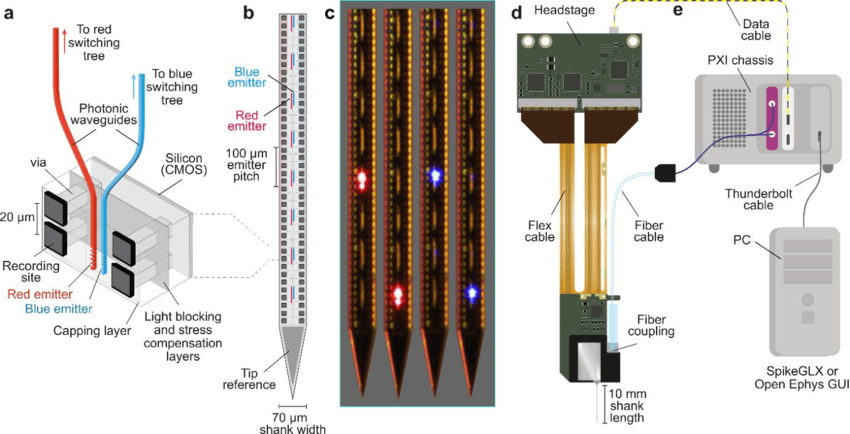
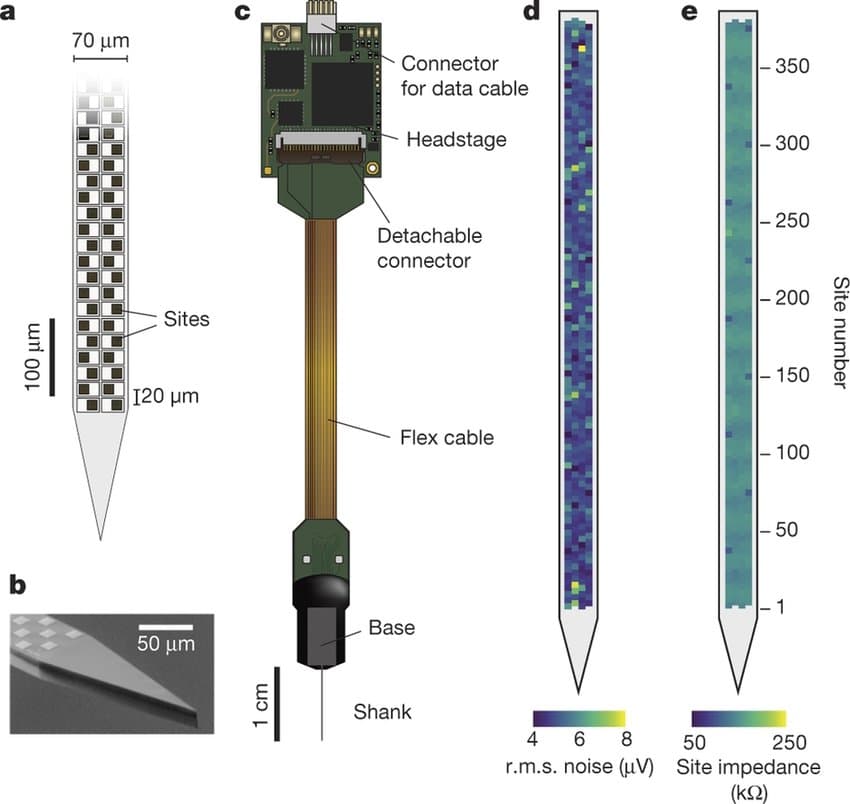
Neuropixels probes, with 10 mm shanks carrying hundreds of traces, exemplify the challenge. Aluminum traces approximately 0.5 μm thick and 10 μm wide over 10 mm length present resistance of 100-1000 Ω per channel. This trace resistance adds thermal noise of 0.05-0.15 μVrms, which is small but not negligible when striving for sub-μVrms total noise.
Neuralink's polyimide threads and Precision's thin-film arrays use thin metal films (typically gold or platinum, 100-500 nm thick) to maintain flexibility. Thinner metal means higher resistance per unit length. The design must balance electrical performance against mechanical requirements for chronic implantation.
Parasitic Capacitance and Crosstalk
Closely spaced traces create parasitic capacitance between channels. When two conductors run parallel, separated by dielectric material, they form an unintended capacitor:
where A is the overlap area and d is the separation distance.
This parasitic capacitance has several effects. First, it creates unintended voltage dividers where some signal "leaks" through the capacitance to ground instead of reaching the amplifier, attenuating the signal before amplification even begins. Second, adjacent traces act like capacitor plates, allowing signals to couple between channels; a signal on channel 5 bleeds into channels 4 and 6, blurring spatial resolution. Third, the combination of trace resistance (R) and parasitic capacitance (C) forms an RC low-pass filter that attenuates high-frequency signal components, limiting the bandwidth of the recording system.
The solution adopted by Neuropixels and similar high-density arrays is on-shank multiplexing. Rather than routing hundreds of traces the full length of the shank, the probe includes active electronics on the shank itself. Signals are buffered and multiplexed locally, reducing the number of long traces to a manageable few. This approach trades silicon area for electrical performance, which is a worthwhile exchange given modern CMOS capabilities.
Input Protection Network
Electrostatic Discharge Properties
Human-implanted devices require protection against electrostatic discharge. During surgical handling and patient interaction, voltage transients of thousands of volts can occur. Without protection, these transients would destroy the sensitive input transistors.
ESD protection typically uses diode clamps that limit voltage excursions to a safe range, along with series resistance for current limiting. The penalty is added capacitance, typically 0.5-2 pF for on-chip protection diodes, and leakage current through the reverse-biased diodes. This protection capacitance contributes to input capacitance that can attenuate high-frequency signals through capacitive division with electrode impedance.
DC Blocking and AC
Neural amplifiers must reject the DC offset voltage that develops at the electrode-electrolyte interface. This offset, arising from electrochemical half-cell potentials and junction potentials, can reach ±300 mV, which is orders of magnitude larger than the microvolt signals of interest. Without DC blocking, this offset would saturate the amplifier.
AC coupling through a series capacitor provides DC rejection while passing neural signals. The input capacitor, typically 10-100 pF for on-chip implementations, forms a high-pass filter with the input resistance. The corner frequency must be low enough (below 0.5 Hz) to pass slow neural signals while rejecting DC drift.
The critical design parameter is input impedance. Signal loss occurs through the voltage divider formed by electrode impedance, trace impedance, and amplifier input impedance:
With 100 MΩ input impedance and 500 kΩ electrode impedance, signal loss is approximately 0.5%, which is negligible. But with only 10 MΩ input impedance, signal loss increases to 5%, and the voltage divider also degrades common-mode rejection ratio. Modern neural amplifiers target input impedance exceeding 100 MΩ, with the best designs achieving 1 GΩ or higher through bootstrapping and chopper techniques.
Low-Noise Amplifier
The low-noise amplifier provides the critical first stage of gain, but in doing so adds its own noise from three fundamental mechanisms. These are explained below.
Thermal Noise and the Fluctuation-Dissipation Theorem
Thermal noise in the amplifier arises from the same physics that generates thermal noise in electrodes and resistors. The fluctuation-dissipation theorem, formalized by Callen and Welton in 1951, establishes that any system which dissipates energy must also exhibit fluctuations (Callen & Welton, 1951).
Consider that if a resistor could dissipate energy without fluctuating, you could connect two resistors at the same temperature and get net energy flow between them, violating the second law of thermodynamics. The fluctuations must exist to maintain equilibrium; the same electron-phonon scattering that allows a resistor to convert electrical energy into heat also causes random electron motions that manifest as voltage noise. This means that no matter how refined your materials, how clean your fabrication, or how clever your circuit design, a component operating above absolute zero with any resistance will exhibit thermal noise of exactly . You can reduce the resistance or narrow the bandwidth, but you cannot beat the formula itself.
At the atomic level in a MOSFET, electrical resistance arises from electron scattering. Electrons flowing through the channel scatter off phonons (quantized lattice vibrations), impurities (substitutional atoms or interstitials), and defects (dislocations and grain boundaries). Each scattering event randomizes electron momentum, dissipating energy as heat. The fluctuation counterpart is thermal noise - random voltage and current fluctuations with power spectral density proportional to temperature and resistance.
For a MOSFET operating in saturation, the drain current noise is:
where γ is a device-dependent parameter approximately equal to 2/3 for long-channel devices but increasing to 1-2 for short-channel devices due to hot carrier effects (Lundberg, 2002). The transconductance gm appears because it determines how efficiently the device converts input voltage fluctuations to output current.
Input-referred thermal noise voltage is:
Maximize transconductance to minimize thermal noise. This favors large transistors biased at high current, but power constraints limit how far this can be pushed in implantable devices. The art of low-noise amplifier design lies in achieving maximum gm per unit power, a metric captured by the noise efficiency factor (NEF).
Flicker Noise: Defects at the Atomic Scale
Flicker noise exhibits a power spectral density inversely proportional to frequency:
where α is approximately 1. This seemingly simple relationship emerges from complex physics at the Si/SiO₂ interface, the boundary between crystalline silicon and amorphous silicon dioxide that forms the heart of every MOSFET.

The McWhorter model attributes 1/f noise to carrier trapping at interface defects (McWhorter, 1957) (Christensson et al., 1968). The atomic picture involves specific defect structures that have been characterized through electron spin resonance spectroscopy (Poindexter & Caplan, 1984) (Lenahan & Conley Jr., 1998).
At the Si/SiO₂ interface, silicon atoms at the crystalline surface cannot complete their tetrahedral bonding arrangement with the amorphous oxide above. The result is dangling bonds - silicon atoms bonded to only three neighbors, with an unpaired electron in the fourth orbital. These are called Pb centers, denoted ·Si≡Si₃ in chemical notation. On (111)-oriented silicon, a single Pb species exists with the dangling bond pointing along the [111] direction. On the more common (100) orientation, two species exist: Pb0 centers located in the second silicon layer from the interface, and Pb1 centers at the topmost silicon layer facing the oxygen atoms of the oxide.
These Pb centers create energy levels within the silicon bandgap, at approximately 0.3 eV and 0.85 eV above the valence band. They act as amphoteric traps, capable of capturing either electrons or holes depending on the Fermi level position. When a carrier is trapped, it is removed from conduction; when released, it returns. This trapping and detrapping creates fluctuations in carrier number that manifest as current noise.
The 1/f spectrum arises from the distribution of trap distances from the interface. Electrons tunnel from the MOSFET channel into oxide traps, with tunneling probability decaying exponentially with distance:
where λ ≈ 0.1 nm is the tunneling attenuation length. Traps at different distances have different characteristic time constants:
A uniform spatial distribution of traps therefore produces a 1/τ distribution of time constants. When many such trapping processes with distributed time constants superimpose, the result is a 1/f power spectrum.
Within the oxide itself, oxygen vacancies create another defect type called E′ centers, with structure ≡Si⁺ Si≡. These positively charged defects can trap holes and contribute to oxide-trapped charge that affects device threshold voltage and noise.
An alternative perspective, championed by Hooge, attributes 1/f noise to mobility fluctuations rather than carrier number fluctuations (Hooge, 1969). In this model, phonon scattering itself fluctuates with a 1/f spectrum. Experimental support includes direct observation of 1/f fluctuations in phonon populations via laser scattering.
Modern understanding recognizes that both mechanisms contribute (Jayaraman & Sodini, 1989). When a carrier is trapped at an interface defect, it not only reduces the number of mobile carriers (the McWhorter effect) but also creates a localized charge that scatters nearby mobile carriers via Coulomb interaction. This correlated mobility fluctuation adds to the noise beyond what number fluctuations alone would predict.
PMOS transistors exhibit 10-100 times lower 1/f noise than NMOS transistors (Lundberg, 2002). This difference arises because PMOS devices operate as buried-channel devices - the hole conduction occurs slightly below the Si/SiO₂ interface rather than directly at it. The spatial separation reduces interaction between carriers and interface traps.
The 1/f noise voltage scales inversely with gate area:
Larger transistors have more traps, but since these traps fluctuate independently, their noise contributions partially cancel through averaging. Doubling the gate area reduces 1/f noise power by half.
Shot Noise in Weak Inversion
When the gate voltage is high enough to fully open the transistor (strong inversion), electrons flow smoothly and continuously through the channel, like water through an open pipe. In this mode, thermal noise dominates.
But neural amplifiers often operate their input transistors in a barely-on state (weak inversion), where the channel is almost closed. Here, electrons don't flow continuously; instead, they must randomly hop over an energy barrier one at a time, like people climbing over a wall rather than walking through an open gate. This discrete, random arrival of individual electrons is what produces shot noise.
In this regime, current consists of discrete carrier injection events, and shot noise becomes relevant:
where q is the electron charge and ID is the drain current. For a typical neural amplifier input stage with ID = 1 μA, shot noise contributes approximately 0.1 μVrms when referred to the input - smaller than thermal or 1/f contributions, but not negligible.
Quantum mechanics reveals deeper structure in shot noise through the Fano factor (F), which measures how much the noise deviates from simple random (Poisson) statistics (Blanter & Büttiker, 2000). When F = 1, you get full shot noise and electrons arrive completely randomly, like raindrops. This occurs in tunnel junctions where electrons rarely make it through. In ordinary metal wires, where electrons scatter repeatedly as they travel, the Fano factor drops to exactly 1/3 and the scattering partially regularizes the electron flow. In extremely clean, narrow channels where electrons travel straight through without scattering, shot noise is suppressed almost entirely (F approaches zero) because electrons pass through one at a time in an orderly sequence, regulated by the Pauli exclusion principle.
For macroscopic neural amplifiers at room temperature, classical shot noise theory applies, but these quantum foundations reveal noise as a probe of fundamental physics rather than just an engineering nuisance.
Amplifier Architecture and Specifications
These noise mechanisms dictate amplifier design choices. The input stage should use PMOS transistors with large gate area, operating in weak-to-moderate inversion to maximize the transconductance-to-current ratio gm/ID (Harrison & Charles, 2003) (Steyaert & Sansen, 1987). Values of 15-25 V⁻¹ are typical for optimized designs, compared to 4-10 V⁻¹ in strong inversion.
The capacitive-coupled instrumentation amplifier (CCIA) architecture has become standard for neural recording. Input capacitors provide DC blocking while maintaining high input impedance. Chopper stabilization, which modulates the signal to higher frequency before amplification and demodulates afterward, moves the signal away from the 1/f-dominated low-frequency region (Enz & Temes, 1996). This technique is particularly valuable for local field potential recording where signal content extends below 1 Hz.
Target specifications for a neural recording amplifier include:
- noise efficiency factor below 3 (theoretical minimum approximately 2.02 for a bipolar differential pair, slightly higher for MOSFETs)
- input impedance exceeding 100 MΩ (preferably above 1 GΩ)
- common-mode rejection ratio above 80 dB (preferably above 100 dB for good power line rejection), and
- power consumption below 10-50 μW per channel to meet thermal constraints of implantable devices
Filtering and Analog-to-Digital Conversion
Bandpass Filtering
Neural amplifiers include filtering to define the signal bandwidth. High-pass filtering removes DC offset and slow drift, typically with corner frequency of 0.1-1 Hz. Low-pass or anti-aliasing filtering prevents high-frequency noise from aliasing into the signal band during digitization, with cutoff typically at 300 Hz to 10 kHz depending on whether the application targets local field potentials or action potential waveforms. Optional notch filtering at 50 or 60 Hz rejects power line interference.
Switched-capacitor filter implementations exhibit kT/C noise arising from thermal noise sampled onto capacitors:
For a 10 pF capacitor at 300 K, this yields approximately 20 μVrms, which is far larger than our noise budget. However, this noise is sampled and aliased into the signal band only once per sample, and subsequent filtering reduces its contribution. The design mitigation is to use larger capacitors where area permits and to oversample sufficiently that digital filtering can remove most of the kT/C noise.
Continuous-time filters using Gm-C (transconductor-capacitor) or RC implementations add resistor thermal noise, typically contributing 0.1-0.2 μVrms in a well-designed system.
Analog-to-Digital Conversion
The ADC discretizes the continuous-amplitude analog signal into digital codes, introducing quantization noise from the mapping of continuous values to discrete levels. For a uniform quantizer, the quantization error is uniformly distributed over ±LSB/2, yielding RMS noise:
For a 10-bit ADC with ±500 μV full-scale range (1 mV total), the LSB is approximately 1 μV and quantization noise is 0.29 μVrms. This is comparable to other noise sources and represents the minimum useful resolution for neural recording. A 12-bit ADC with the same range yields quantization noise of 0.07 μVrms, providing comfortable margin.
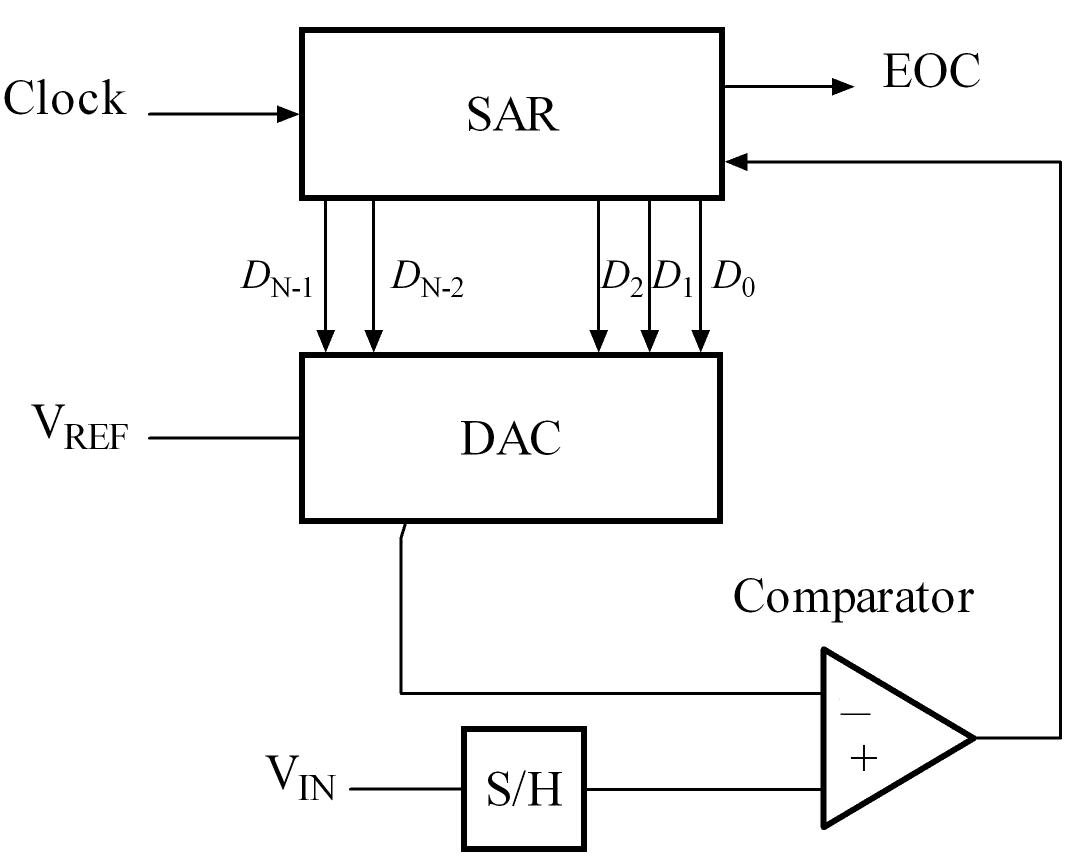
Two ADC architectures dominate neural recording applications. Successive approximation register (SAR) ADCs offer power efficiency and moderate resolution (10-16 bits), making them suitable for per-channel conversion in high-density arrays. Neuralink and many other systems use SAR converters.
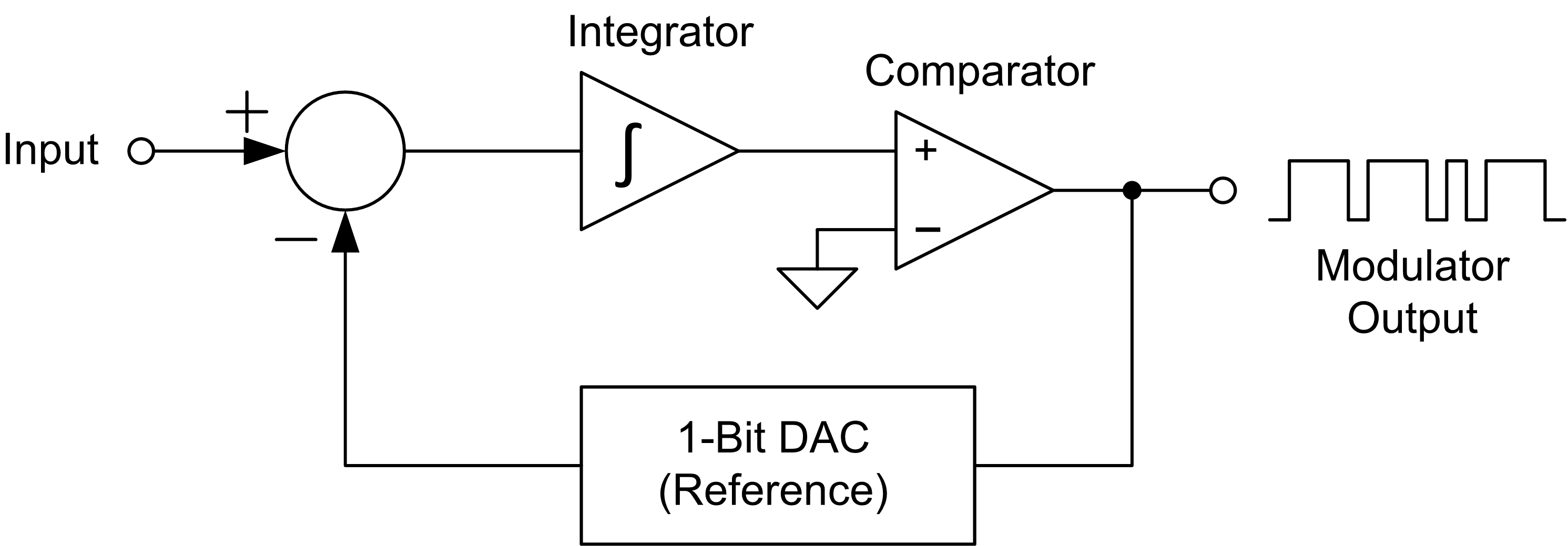
Delta-sigma (ΣΔ) ADCs use oversampling and noise shaping to achieve very high resolution (16-24 effective bits) at higher power cost. They excel in precision measurement applications but are less common in implantable neural interfaces due to power constraints.
The key design guideline is that quantization noise should be well below the analog noise floor. If the amplifier and electrode together contribute 1 μVrms, the ADC should contribute less than 0.3 μVrms to avoid degrading overall noise performance. With this criterion, 10-12 bit ADCs are adequate for most neural recording applications.
Digital Processing, Transmission, Reference, and Power
Digital Signal Processing
Digital processing can introduce computational artifacts including finite-precision round-off errors in filtering, spike sorting errors from misclassification or merged units, and compression artifacts when lossy compression is used to meet bandwidth constraints. The mitigation is to use sufficient bit depth in DSP operations (16-32 bit fixed point or floating point), validate that algorithms do not introduce correlated noise patterns, and accept that real-time constraints may limit algorithm complexity.
Data Transmission
Wired percutaneous systems like Blackrock's NeuroPort achieve high bandwidth (96 channels × 30 kHz × 16 bits = 46 Mbps) but create infection risk and mechanical failure points at the skin interface. Wireless systems eliminate these risks but face bandwidth constraints.
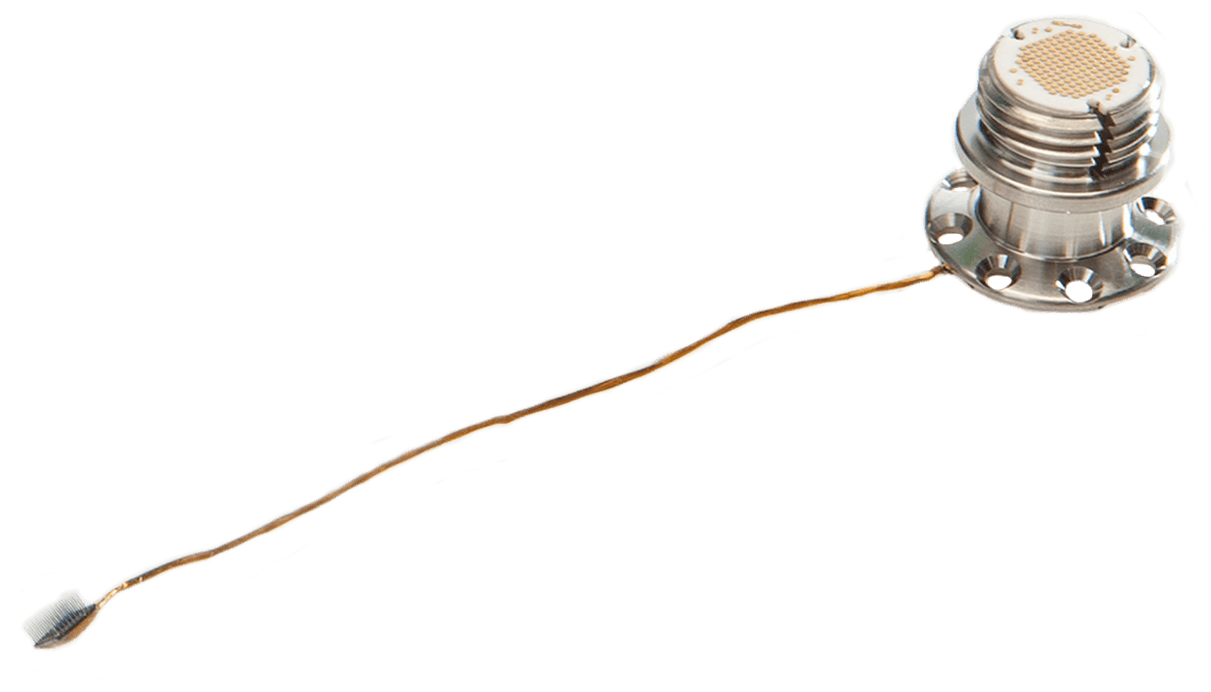
WIMAGINE uses an inductive data link at 13.56 MHz, transmitting 64 channels at 586 Hz sample rate with 12-bit resolution for approximately 450 kbps total throughput (Mestais et al., 2015). This bandwidth permits transmission of local field potentials and low-gamma activity but not full-bandwidth action potential waveforms. The carrier frequency must be filtered from analog circuits to prevent coupling noise into the signal path.

Neuralink's N1 faces even tighter constraints with 1024 channels. On-chip compression is essential, requiring spike detection and waveform compression before transmission over Bluetooth Low Energy. The compression algorithm must preserve relevant neural information while achieving the required data rate reduction.
Reference Electrode and Common-Mode Rejection
Neural signals are inherently differential - we measure the voltage between a recording electrode and a reference electrode. Common-mode signals that appear equally on both electrodes, such as power line interference and motion artifacts, should be rejected through common-mode rejection:
Target CMRR exceeds 80 dB, preferably 100 dB or higher. However, CMRR degrades if the reference electrode impedance differs from the recording electrode impedance. The effective CMRR becomes:
With 100 kΩ impedance mismatch between recording and reference electrodes, and only 10 MΩ amplifier input impedance, CMRR degrades by 40 dB, which is potentially catastrophic for power line rejection. The solution is to maximize input impedance and match reference electrode impedance to the recording electrodes as closely as possible.
Percutaneous wired systems can also suffer from ground loops between the implant and external equipment, creating paths for 50/60 Hz current to flow through the patient. Fully implantable wireless systems eliminate ground loops entirely, contributing to their improved noise performance in practical use.
Power Supply
The power supply rejection ratio (PSRR) determines how much power supply noise couples into the signal:
Target PSRR exceeds 60 dB at DC and 40 dB at frequencies relevant to neural signals.
Wireless power transfer creates particular challenges. WIMAGINE receives power inductively at 13.56 MHz, and Neuralink at approximately 6.78 MHz. The high-frequency carrier can couple capacitively or inductively into analog circuits. Rectification produces ripple at the carrier frequency and its harmonics. Load variations during neural recording cause supply voltage fluctuations.
Mitigation requires multiple regulation stages, typically a low-dropout regulator (LDO) following the rectifier, along with extensive on-chip decoupling capacitance and careful physical layout separating RF power circuits from sensitive analog circuits. Battery-powered implantable systems like Neuralink face the additional challenge that battery voltage decreases as the battery depletes, requiring design for operation over the full voltage range, and charging transients can inject noise during recharge cycles.
Chronic Considerations
Hermetic Package Integrity
Long-term implants require hermetic sealing to prevent moisture and ion ingress that would cause corrosion and electronics failure. The gold standard, proven in pacemakers and cochlear implants over decades, is welded titanium enclosures with glass or ceramic feedthroughs for electrical connectors.
Helium leak testing characterizes hermeticity, with typical specifications requiring leak rates below 10⁻⁹ atm·cc/s. This corresponds to moisture accumulation of micrograms per year, which is slow enough to permit decades of operation with appropriate internal desiccants and moisture-tolerant design.
The failure mode of non-hermetic packages is insidious. Moisture initially causes slight parameter shifts as humidity affects transistor characteristics. Over months to years, electrochemical corrosion attacks metal traces and bond wires. Eventually, leakage currents between conductors cause functional failure. Modern BCI implants like WIMAGINE and Neuralink use titanium packages specifically to achieve the hermeticity required for lifelong implantation.
Electrode and Interface Evolution
Electrodes change over the implant lifetime. For platinum electrodes in recording mode (no DC current), dissolution is minimal, and the platinum surface is thermodynamically stable in physiological saline. Surface contamination from protein adsorption and mineral deposits is more significant, gradually changing the electrode's electrochemical properties and impedance.
Coated electrodes face additional degradation mechanisms. PEDOT:PSS, while achieving excellent initial impedance, delaminates from underlying metal over time due to mechanical stress, swelling, and electrochemical breakdown. Published studies show significant degradation within 1-2 years, making PEDOT unsuitable for 20-year implants. Iridium oxide coatings show better stability but still lack the decades-long track record of uncoated platinum-iridium alloys.
The tissue interface also evolves. Encapsulation tissue stabilizes over 3-6 months, after which it remains relatively constant. Signal amplitudes decrease during this period as the fibrous capsule interposes between electrode and neural tissue, but the decrease eventually plateaus. Decoding algorithms can adapt to the changed signal characteristics, maintaining BCI performance despite reduced signal amplitude.
Conclusion
Biological background noise sets an irreducible floor of 5-10 μVrms for epidural ECoG. All electronic noise sources combined - electrodes, amplifiers, filters, ADCs - contribute roughly 1-1.5 μVrms, meaning further optimization of electronics yields diminishing returns. There are probably more gains to be made in signal processing and decoder design than there are in hardware refinement, at this point.
For chronic implants, my analysis supports bare Pt-Ir electrodes with decades of proven stability outperforming novel coatings that offer lower initial impedance but uncertain longevity. The 0.3-0.4 μVrms noise reduction from PEDOT:PSS is negligible against biological background and not worth the delamination risk over a 20-year implant lifetime.
References
- Benabid, A., et al. (2019). An exoskeleton controlled by an epidural wireless brain-machine interface in a tetraplegic patient: a proof-of-concept demonstration. The Lancet Neurology, 18(12), 1112-1122. doi:10.1016/S1474-4422(19)30321-7
- Henze, D., Borhegyi, Z., Csicsvari, J., Mamiya, A., Harris, K., & Buzsáki, G. (2000). Intracellular features predicted by extracellular recordings in the hippocampus in vivo. Journal of Neurophysiology, 84(1), 390-400. doi:10.1152/jn.2000.84.1.390
- Buzsáki, G. (2004). Large-scale recording of neuronal ensembles. Nature Neuroscience, 7(5), 446-451. doi:10.1038/nn1233
- Gold, C., Henze, D., Koch, C., & Buzsáki, G. (2006). On the origin of the extracellular action potential waveform: A modeling study. Journal of Neurophysiology, 95(5), 3113-3128. doi:10.1152/jn.00979.2005
- Pettersen, K., & Einevoll, G. (2008). Amplitude variability and extracellular low-pass filtering of neuronal spikes. Biophysical Journal, 94(3), 784-802. doi:10.1529/biophysj.107.111179
- Buzsáki, G., Anastassiou, C., & Koch, C. (2012). The origin of extracellular fields and currents — EEG, ECoG, LFP and spikes. Nature Reviews Neuroscience, 13(6), 407-420. doi:10.1038/nrn3241
- Xing, D., Yeh, C., & Shapley, R. (2009). Spatial spread of the local field potential and its laminar variation in visual cortex. Journal of Neuroscience, 29(37), 11540-11549. doi:10.1523/JNEUROSCI.2573-09.2009
- Kajikawa, Y., & Schroeder, C. (2011). How local is the local field potential?. Neuron, 72(5), 847-858. doi:10.1016/j.neuron.2011.09.029
- Dubey, A., & Ray, S. (2016). Spatial spread of local field potential is band-pass in the primary visual cortex. Journal of Neurophysiology, 116(4), 1986-1999. doi:10.1152/jn.00443.2016
- Ludwig, K., Langhals, N., Joseph, M., Richardson-Burns, S., Hendricks, J., & Kipke, D. (2011). Poly(3,4-ethylenedioxythiophene) (PEDOT) polymer coatings facilitate smaller neural recording electrodes. Journal of Neural Engineering, 8(1), 014001. doi:10.1088/1741-2560/8/1/014001
- Cogan, S. (2008). Neural stimulation and recording electrodes. Annual Review of Biomedical Engineering, 10, 275-309. doi:10.1146/annurev.bioeng.10.061807.160518
- Rocha, P., et al. (2016). Electrochemical noise and impedance of Au electrode/electrolyte interfaces enabling extracellular detection of glioma cell populations. Scientific Reports, 6, 34843. doi:10.1038/srep34843
- Callen, H., & Welton, T. (1951). Irreversibility and generalized noise. Physical Review, 83(1), 34-40. doi:10.1103/PhysRev.83.34
- Lundberg, K. (2002). Noise sources in bulk CMOS. MIT OpenCourseWare. [Link]
- McWhorter, A. (1957). 1/f noise and germanium surface properties.
- Christensson, S., Lundström, I., & Svensson, C. (1968). Low frequency noise in MOS transistors—I. Theory. Solid-State Electronics, 11(9), 797-812. doi:10.1016/0038-1101(68)90100-7
- Poindexter, E., & Caplan, P. (1984). Characterization of Si/SiO₂ interface defects by electron spin resonance. Progress in Surface Science, 14(3), 201-294. doi:10.1016/0079-6816(83)90006-0
- Lenahan, P., & Conley Jr., J. (1998). What can electron paramagnetic resonance tell us about the Si/SiO₂ system?. Journal of Vacuum Science & Technology B, 16(4), 2134-2153. doi:10.1116/1.590301
- Hooge, F. (1969). 1/f noise is no surface effect. Physics Letters A, 29(3), 139-140. doi:10.1016/0375-9601(69)90076-0
- Jayaraman, R., & Sodini, C. (1989). A 1/f noise technique to extract the oxide trap density near the conduction band edge of silicon. IEEE Transactions on Electron Devices, 36(9), 1773-1782. doi:10.1109/16.34242
- Blanter, Y., & Büttiker, M. (2000). Shot noise in mesoscopic conductors. Physics Reports, 336(1-2), 1-166. doi:10.1016/S0370-1573(99)00123-4
- Harrison, R., & Charles, C. (2003). A low-power low-noise CMOS amplifier for neural recording applications. IEEE Journal of Solid-State Circuits, 38(6), 958-965. doi:10.1109/JSSC.2003.811979
- Steyaert, M., & Sansen, W. (1987). A micropower low-noise monolithic instrumentation amplifier for medical purposes. IEEE Journal of Solid-State Circuits, 22(6), 1163-1168. doi:10.1109/JSSC.1987.1052869
- Enz, C., & Temes, G. (1996). Circuit techniques for reducing the effects of op-amp imperfections: autozeroing, correlated double sampling, and chopper stabilization. Proceedings of the IEEE, 84(11), 1584-1614. doi:10.1109/5.542410
- Mestais, C., Charvet, G., Sauter-Starace, F., Foerster, M., Ratel, D., & Benabid, A. (2015). WIMAGINE: wireless 64-channel ECoG recording implant for long term clinical applications. IEEE Transactions on Neural Systems and Rehabilitation Engineering, 23(1), 10-21. doi:10.1109/TNSRE.2014.2333541